4 ways to turn retrospectives into action.
Your team finishes a project. You hold a retrospective. People share thoughtful insights. Patterns emerge. Notes get captured. Then nothing changes. The same issues show up in the next cycle. The same friction slows the work. The same conversations repeat.
Reflection only works when it reshapes what happens next. Otherwise, it becomes a check-the-box exercise where good thinking goes to die. Insights alone don’t drive change – action does.
If retrospectives don’t lead to action, they’re just well-documented frustration.
Done right, reflection is one of the most powerful tools in work. Retrospectives help teams learn faster than the pace of change, turn mistakes into assets, improve systems and outputs, and build trust through shared accountability.
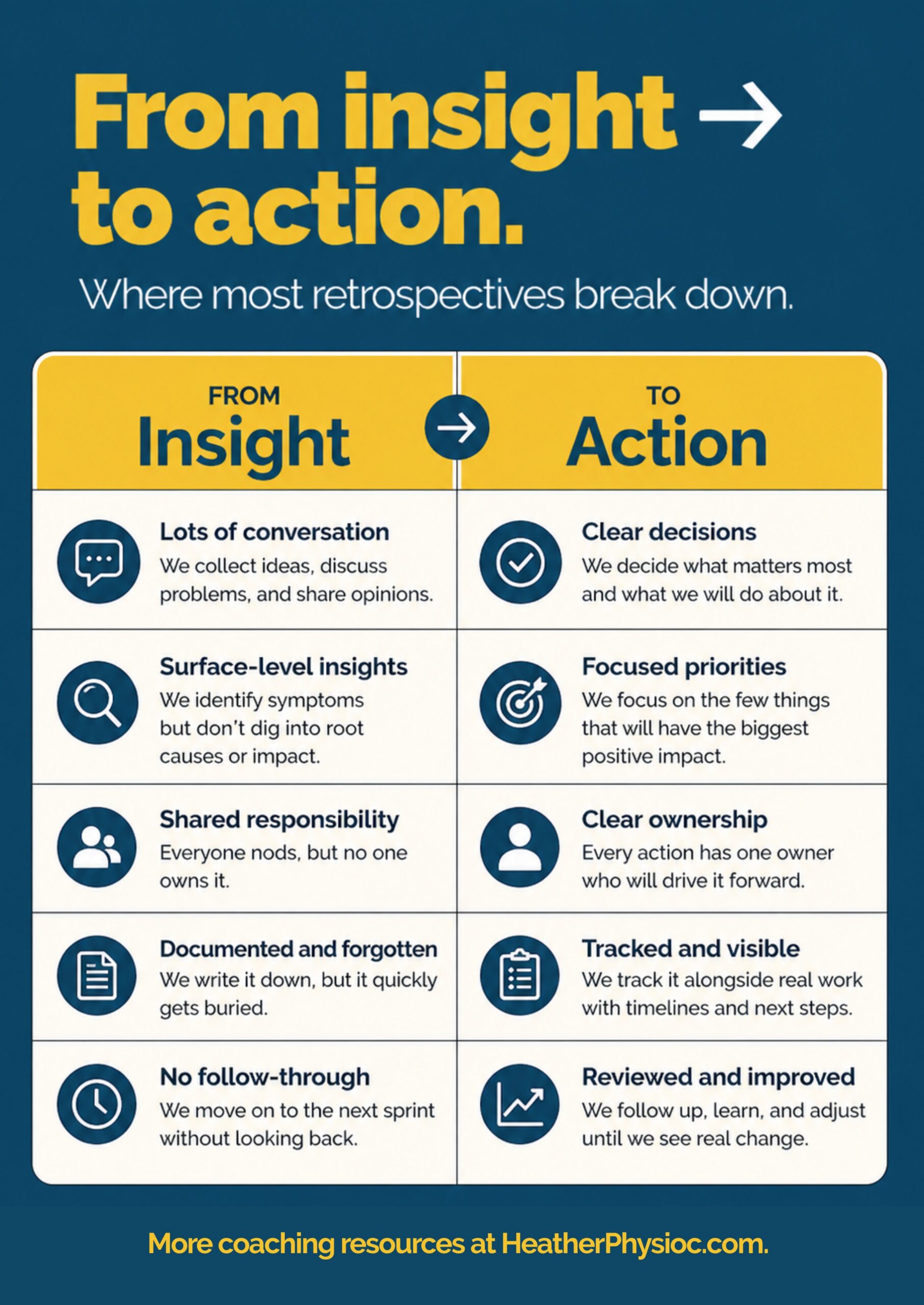
So where do they go wrong? Most retrospectives fail in the same places. They generate insights, but stop short of decisions. Everyone leaves with observations, but not commitments.
If you want reflection to matter, you need to close that gap, every time.
Retros only work when they are treated as a core part of how work gets better. The goal isn’t to surface everything; it’s to create forward momentum. That requires a shift in mindset from reflection as discussion to reflection as decision-making.
The difference between stalled reflection and real progress comes down to a few simple, repeatable practices
People are far more willing to be candid when they see that speaking up leads to action, not consequences, and that improvement is an expectation, not a threat. That means focusing feedback on the work, creating space for honest input, and most importantly, following through in visible ways. Over time, this builds something more valuable than any single fix: trust. And trust is what turns reflection into a repeatable engine for improvement.
These are the four key components of turning insights into action after a retrospective:
Documentation
Documentation is how learning becomes durable, turning fleeting conversations into a shared source of truth that can shape future decisions. It forces clarity on what actually matters, not just what was said. If everything is a priority, nothing changes, so focus on the vital few next best actions.
- Capture and share full notes about what worked, what didn’t, and what to do next.
- Clearly prioritize 3 to 5 next best actions, rather than a laundry list of all proposed actions.
- Define each item clearly: what’s happening, where it shows up, why it matters. Include direction on where to start chipping away at the challenge.
Ownership
Ownership creates motion; without it, ideas stall. Ownership is what converts intention into motion by making each prioritized improvement someone’s responsibility, not everyone’s awareness. It creates agency, which is essential for change to take hold.
- Assign one clear owner per action—someone accountable for driving it forward. Otherwise, when everyone is responsible, no one is responsible, and change stalls.
- Define what ownership actually means in this context: what decisions they can make, what changes they are responsible for influencing, and where their scope begins and ends.
- Ensure the owner has the support to succeed, including visibility to stakeholders, access to resources, and a clear path to escalate blockers when needed.
Accountability
Accountability is the mechanism that elevates improvement work to the same level of importance as delivery. It ensures that reflection isn’t optional, but an expected part of performance and future action.
- Make improvement work visible and trackable alongside delivery work – if it lives outside the system, it won’t compete for attention.
- Attach clear timelines and next actions so progress can be measured.
- Create shared visibility so teams and leaders can see what’s moving, what’s stalled, and where intervention is needed.
- Reflection should shape planning, not sit outside of it. To improve outcomes, put actions from the retrospective into the same project management system you use to deliver work.
Follow-Up
Most teams don’t fail at reflection – they fail at follow-through. Start the next retrospective with the last one. Follow-up is what transforms reflection into progress by proving that feedback leads to real change. It reinforces trust over time, showing that speaking up is welcome and has an impact.
- Revisit prior actions at the start of the next cycle to assess what moved, what stalled, and what was learned.
- When something isn’t moving, don’t let it linger – either escalate it or let it go. Lack of movement should trigger action or revisiting whether the need is a true priority.
- Close the loop by communicating outcomes clearly, including what worked, what didn’t, and what will change next.
- Don’t forget to communicate progress to people impacted outside the retrospective room.
Trust is the true currency of retrospectives, and it’s earned through visible change.
Forward momentum matters more than perfect solutions. Create an environment where challenge is treated as contribution, not threat. Create an environment where feedback is aimed at improving the work. not judging the person. Psychological safety and growth-focused contributions are built through consistent action, visible follow-through, and leaders who model candor and reward dissent. Better teams aren’t built by avoiding discomfort, but by working through it, together, and turning that learning into tangible progress.